

Meaningful Results With HEPCLUDEX: A Path Forward for Chronic HDV Patients1

A Phase 3 Trial on the Efficacy and Safety of HEPCLUDEX1

MYR301 was a multicenter, open-label, randomized, Phase 3 study in adults with chronic HDV without cirrhosis or with compensated cirrhosis1,a
Key Entry Criteria1
  • Adults with chronic HDV without cirrhosis or with compensated cirrhosis
  • ALT >1× to <10× ULN
  • Positive serum HDV RNA
  • Platelets ≥60,000 cells/mm3
  • NA therapy permitted for those meeting
    HBV guideline criteria
The MYR301 protocol specified the dose as 10 mg; however, a dose recovery study later showed that the delivered dose was 8.5 mg1

ALT=alanine aminotransferase; NA=nucleos(t)ide analog; ULN=upper limit of normal.

aRandomization was stratified by the presence or absence of compensated cirrhosis.

bUndetectable HDV RNA was defined as < lower limit of quantification (LLOQ) (50 IU/mL) with target not detected.

cNormalization of the ALT level was defined as an ALT level within the normal range as assessed according to central laboratory
criteria (≤31 U/L for women and ≤41 U/L for men in Russia; ≤34 U/L and ≤49 U/L, respectively, in all other locations).

HEPCLUDEX Was Evaluated in a Broad Range of Patients1

The average age was 41 years, 48% had compensated cirrhosis, and 59% were on concomitant NA therapy.1,2

ALT=Alanine aminotransferase; NA=nucleos(t)ide analog; SD=standard deviation.

Week 48 Results

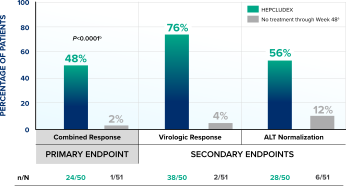
Patients on HEPCLUDEX Achieved Significant Combined Response vs Those With No Treatment at Week 481

48% of patients achieved a combined response at 48 weeks, including 76% with a virologic response and 56% achieving ALT normalization1
MYR301 Phase 3 Trial Results at Week 481,2:

Combined response, virologic response, and ALT normalization at Week 48 in patients with chronic HDV infection and compensated liver disease (Full Analysis Set)1,2

MYR301 Phase 3 trial results at Week 48 showing HEPCLUDEX® efficacy across combined response (48%), virologic response (76%), and ALT normalization (56%) compared to no-treatment control groups.

Combined response: Undetectable HDV RNA or decrease by ≥2 log10 IU/mL from baseline and ALT normalization.1

Virologic response: Undetectable HDV RNA or decrease by ≥2 log10 IU/mL from baseline.1

aDelayed Treatment arm received no treatment for 48 weeks.

bP<0.0001 (by Fisher’s exact test) for HEPCLUDEX vs No Treatment through Week 48.1

Most common adverse reactions (incidence ≥10%; all grades) in HEPCLUDEX clinical trials were injection site reactions, headache, abdominal pain, fatigue, and pruritus.1

Year 3 (Week 144) Results

Treatment Response With HEPCLUDEX Was Maintained 

Through 3 Years1

HEPCLUDEX treatment arm data
 
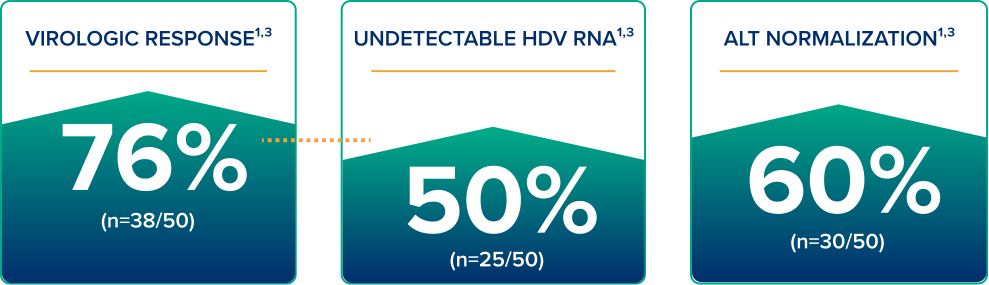
54% OF PATIENTS SAW A COMBINED RESPONSE AT ~3 YEARS1,3 
 
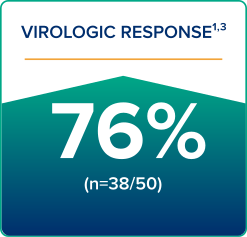
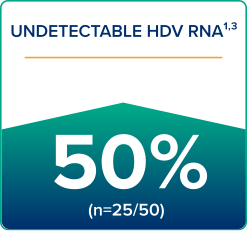
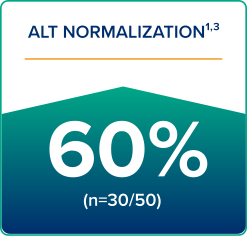
In the Delayed Treatment arm at Week 144, 92% (46/50) achieved virologic response, 58% (29/50) achieved ALT normalization, 52% (26/50) achieved undetectable HDV RNA, and 56% (28/50) achieved combined response. Delayed Treatment arm received no treatment for 48 weeks.3

HEPCLUDEX: No Antiviral Resistance1

No baseline resistance to HEPCLUDEX identified in virologic responders or the resistance analysis population in clinical trials1,a
  • Resistance analysis was performed for participants who had virologic non-response (HDV RNA decline <1 log10 IU/mL from baseline) or who experienced virologic breakthrough (2 consecutive increases in HDV RNA of ≥1 log10 IU/mL from nadir or 2 consecutive HDV RNA values ≥ lower limit of quantification [LLOQ] if previously < LLOQ during treatment with HEPCLUDEX). In Trials MYR301 and MYR204, resistance analysis was performed for 13/150 participants at Week 48, 20/150 participants at Week 96, and 5/50 participants at Week 144 on HEPCLUDEX treatment (n=24 unique participants)1
  • No baseline polymorphisms identified in the HEPCLUDEX region of HBsAg or in HDAg were associated with virologic non-response or breakthrough1
  • Similarly, no post-baseline substitutions in the HEPCLUDEX region or in HDAg showed an association with virologic breakthrough1
  • All identified baseline and post-baseline variants retained susceptibility to HEPCLUDEX in cell culture assays. A positive control for resistance was not available for these experiments1
Cross-Resistance
Cross-Resistance

Cross-resistance is not expected between HEPCLUDEX and nucleos(t)ide analog reverse transcriptase inhibitors approved for the treatment of chronic HBV infection given their different mechanisms of action.1

HDAg=hepatitis delta antigen.

0% resistance with HEPCLUDEX®.
2 Years Off Treatment

Efficacy Continued for Some Patients Posttreatment3

In the HEPCLUDEX treatment arm, ~2 years after treatment ended, some patients continued
to demonstrate a response3

24% of patients maintained a combined response at ~2 years after treatment ended1,3,a

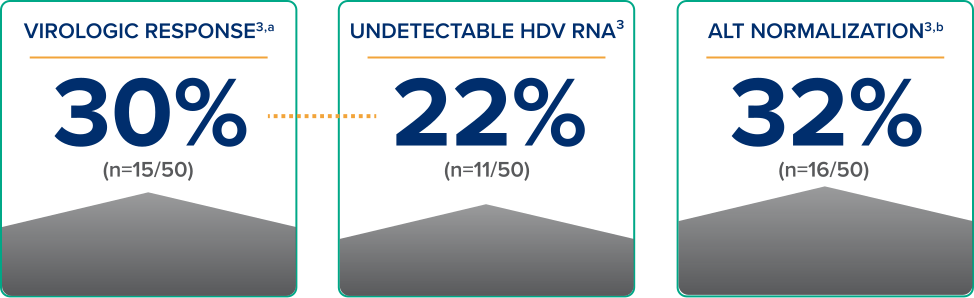
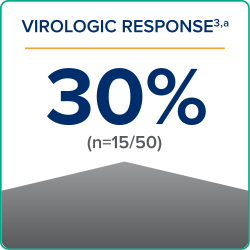
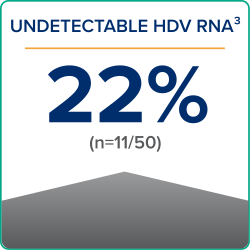
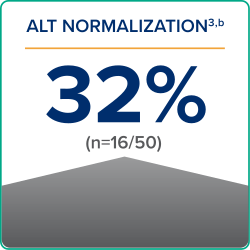
In the Delayed Treatment arm, ~2 years after treatment ended, 32% (16/50)b achieved virologic response, 28% (14/50)a achieved ALT normalization, 20% (10/50) achieved undetectable HDV RNA, and 24% (12/50)a achieved combined response.3
Exploratory endpoint:
Virologic response and ALT normalization at ~2 years posttreatment were exploratory endpoints. The data are descriptive only and are not included in the HEPCLUDEX Prescribing Information.3
 
HEPCLUDEX should be continued as long as it is associated 
with a response to treatment1
 

Combined response: Undetectable HDV RNA or decrease by ≥2 log10 IU/mL from baseline and ALT normalization.1

Virologic response: Undetectable HDV RNA or decrease by ≥2 log10 IU/mL from baseline.1

aIncludes one responder who restarted HEPCLUDEX prior to the visit.3

bIncludes 2 responders who restarted HEPCLUDEX prior to the visit.3

INDICATION1

HEPCLUDEX is indicated for the treatment of chronic hepatitis delta virus (HDV) infection in adults without cirrhosis or with compensated cirrhosis.

This indication is approved under accelerated approval based on a decrease in HDV RNA and alanine aminotransferase (ALT) normalization. An improvement in disease-related clinical outcomes has not been established. Continued approval for this indication may be contingent upon verification and description of clinical benefit in a confirmatory trial(s).

Please see full Prescribing Information for HEPCLUDEX, including BOXED WARNING and Instructions for Use.

IMPORTANT SAFETY INFORMATION

BOXED WARNING: POSTTREATMENT SEVERE ACUTE EXACERBATION OF HEPATITIS D and B

Severe acute exacerbations of hepatitis D and hepatitis B may occur after HEPCLUDEX is discontinued, especially in patients with cirrhosis, who may be at increased risk of more severe flares or progression to hepatic decompensation. Monitor hepatic function closely with both clinical and laboratory follow-up, including hepatitis B virus (HBV) DNA and hepatitis delta virus (HDV) RNA viral load, for at least six months in patients who discontinue HEPCLUDEX. Resumption of antiviral therapy may be warranted.

Warnings and Precautions

Hypersensitivity Reactions Including Anaphylaxis: Hypersensitivity reactions, including anaphylaxis, have been reported with HEPCLUDEX. If signs or symptoms of a clinically significant hypersensitivity reaction or anaphylaxis occur, immediately discontinue HEPCLUDEX and initiate appropriate treatment.

Adverse Reactions

Most common adverse reactions (incidence ≥10%; all grades) in HEPCLUDEX clinical trials were injection site reactions, headache, abdominal pain, fatigue and pruritus.

Dosage and Administration

  • Dosage in adults: 8.5 mg once daily administered by subcutaneous injection.
  • HEPCLUDEX should be continued as long as it is associated with a response to treatment. The optimal treatment duration is unknown.
  • In all patients, manage the underlying hepatitis B virus (HBV) infection as clinically appropriate.

Pregnancy and Lactation

  • Pregnancy: There are insufficient data from human pregnancies exposed to HEPCLUDEX to allow an assessment of a drug-associated risk of major birth defects, miscarriage, or other adverse maternal or fetal outcomes.
  • Lactation: There are no data on the presence of HEPCLUDEX in human milk, the effects on the breastfed infant, or the effects on milk production. The developmental and health benefits of breastfeeding should be considered along with the mother's clinical need for HEPCLUDEX and any potential adverse effects on the breastfed child from HEPCLUDEX or from the underlying maternal condition.

References:

1. HEPCLUDEX. Prescribing Information. Foster City, CA: Gilead Sciences, Inc.; May 2026. 2. Wedemeyer H, et al. N Engl J Med. 2023;389(1):22-32. 3. Wedemeyer H, et al. J Hepatol. Published online April 9, 2026. doi:10.1016/j.jhep.2026.03.046